
Urban inequalities and poverty

Future of urban inequalities
How inequalities in cities will evolve over the next decade
Across Europe, cities are taking bold action to fight poverty, reduce inequality, invest in affordable housing and build more inclusive, resilient communities.
But the pressure is mounting. Rising living costs, growing difficulties in finding affordable housing and stable jobs, and tighter local budgets are making it harder for cities to protect residents, especially those most at risk. Without stronger and more direct EU support, cities will face increasing limits in delivering essential services.
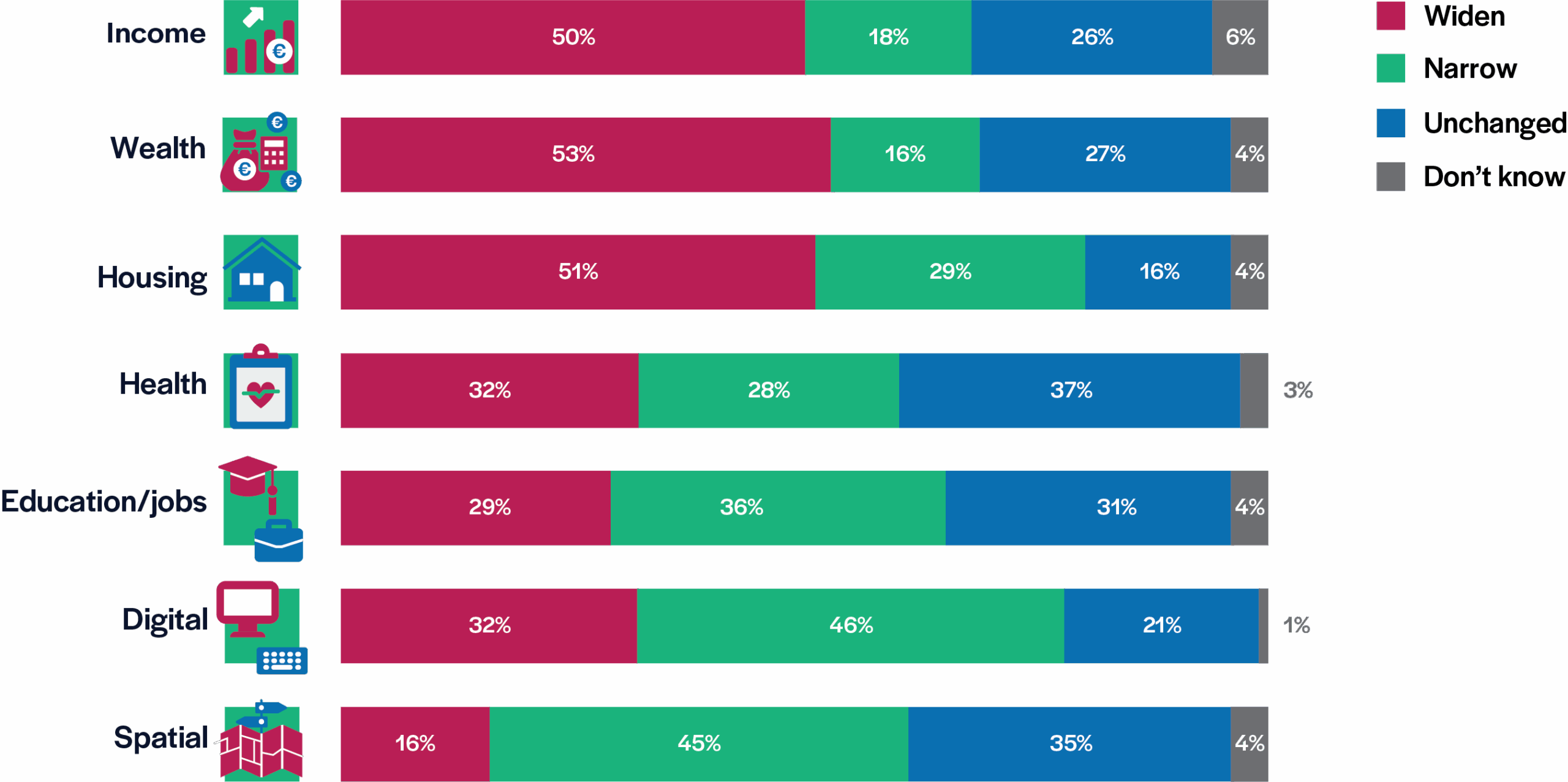
To better understand how these pressures may evolve, this year’s Eurocities Pulse Mayors Survey looks at how city leaders expect seven inequality gaps to evolve in their cities over the next decade: income, household assets and wealth, housing affordability, health and healthy life expectancy, education and access to good jobs, digital access and skills, and spatial segregation between neighbourhoods.
A first notable pattern in the answers shows that cities are most concerned about gaps due to income, wealth and housing – areas driven largely by broader economic and policy forces. By contrast, they are more optimistic about gaps they can directly influence through local action, such as digital access, skills and neighbourhood inclusion.
Overall, housing affordability stands out as the biggest concern. Over half of cities expect the affordability gap to widen over the next decade, while only 29% expect it to narrow. A similar pattern appears for wealth (53%) and income (50%), with both expected to widen. Based on these figures, cities are warning: without stronger action, the cost of living and the unequal distribution of assets will push urban inequality further.
By contrast, cities are more confident about closing capability gaps. On digital access and skills, cities are evenly split between those who see the gap narrowing and those who see it widening, while one in five foresee little change. On spatial segregation, the outlook is more positive: 45% of cities expect gaps between neighbourhoods to narrow, compared with 16% anticipating a widening. The more positive outlook is linked to local programmes already underway, from improving digital access to investing in neighbourhood renewal and transport.
Education, skills and access to good jobs sit somewhere in the middle. More cities foresee this gap narrowing (36%) rather than widening (29%), suggesting cities are confident in the measures they’ve put in place such as apprenticeships, training, short skills courses and direct links with employers. At the same time, the figures show that these opportunities remain fragile, especially in labour markets that are changing quickly.
Health and healthy life expectancy present a more mixed picture. Cities are almost evenly divided: 32% expect the gap to widen and 28% to narrow, while the largest group predict little change. Local leaders believe progress will depend on whether they can scale prevention, primary care, remote healthcare services and community-based support quickly enough to meet growing demographic and social pressures.
Across Europe, the picture varies widely. Some cities expect to narrow several gaps at once, while others see inequality widening on most fronts, reflecting differences in housing market, labour structures, fiscal space and service capacity. Despite differences, mayors agree that without stronger action, key gaps will widen, especially in areas shaped by wider economic forces, while cities are better placed to make progress where they can act directly. This highlights the need for stronger backing from national and European levels particularly in areas cities cannot tackle alone.
Future of urban inequalities
Across Europe, cities are taking bold action to fight poverty, reduce inequality, invest in affordable housing and build more inclusive, resilient communities.
But the pressure is mounting. Rising living costs, growing difficulties in finding affordable housing and stable jobs, and tighter local budgets are making it harder for cities to protect residents, especially those most at risk. Without stronger and more direct EU support, cities will face increasing limits in delivering essential services.
To better understand how these pressures may evolve, this year’s Eurocities Pulse Mayors Survey looks at how city leaders expect seven inequality gaps to evolve in their cities over the next decade: income, household assets and wealth, housing affordability, health and healthy life expectancy, education and access to good jobs, digital access and skills, and spatial segregation between neighbourhoods.
How inequalities in cities will evolve over the next decade
A first notable pattern in the answers shows that cities are most concerned about gaps due to income, wealth and housing – areas driven largely by broader economic and policy forces. By contrast, they are more optimistic about gaps they can directly influence through local action, such as digital access, skills and neighbourhood inclusion.
Overall, housing affordability stands out as the biggest concern. Over half of cities expect the affordability gap to widen over the next decade, while only 29% expect it to narrow. A similar pattern appears for wealth (53%) and income (50%), with both expected to widen. Based on these figures, cities are warning: without stronger action, the cost of living and the unequal distribution of assets will push urban inequality further.
By contrast, cities are more confident about closing capability gaps. On digital access and skills, cities are evenly split between those who see the gap narrowing and those who see it widening, while one in five foresee little change. On spatial segregation, the outlook is more positive: 45% of cities expect gaps between neighbourhoods to narrow, compared with 16% anticipating a widening. The more positive outlook is linked to local programmes already underway, from improving digital access to investing in neighbourhood renewal and transport.
Education, skills and access to good jobs sit somewhere in the middle. More cities foresee this gap narrowing (36%) rather than widening (29%), suggesting cities are confident in the measures they’ve put in place such as apprenticeships, training, short skills courses and direct links with employers. At the same time, the figures show that these opportunities remain fragile, especially in labour markets that are changing quickly.
Health and healthy life expectancy present a more mixed picture. Cities are almost evenly divided: 32% expect the gap to widen and 28% to narrow, while the largest group predict little change. Local leaders believe progress will depend on whether they can scale prevention, primary care, remote healthcare services and community-based support quickly enough to meet growing demographic and social pressures.
Across Europe, the picture varies widely. Some cities expect to narrow several gaps at once, while others see inequality widening on most fronts, reflecting differences in housing market, labour structures, fiscal space and service capacity. Despite differences, mayors agree that without stronger action, key gaps will widen, especially in areas shaped by wider economic forces, while cities are better placed to make progress where they can act directly. This highlights the need for stronger backing from national and European levels particularly in areas cities cannot tackle alone.
Regional differences
Levels of urban inequality vary across Europe, with different patterns emerging in different regions.
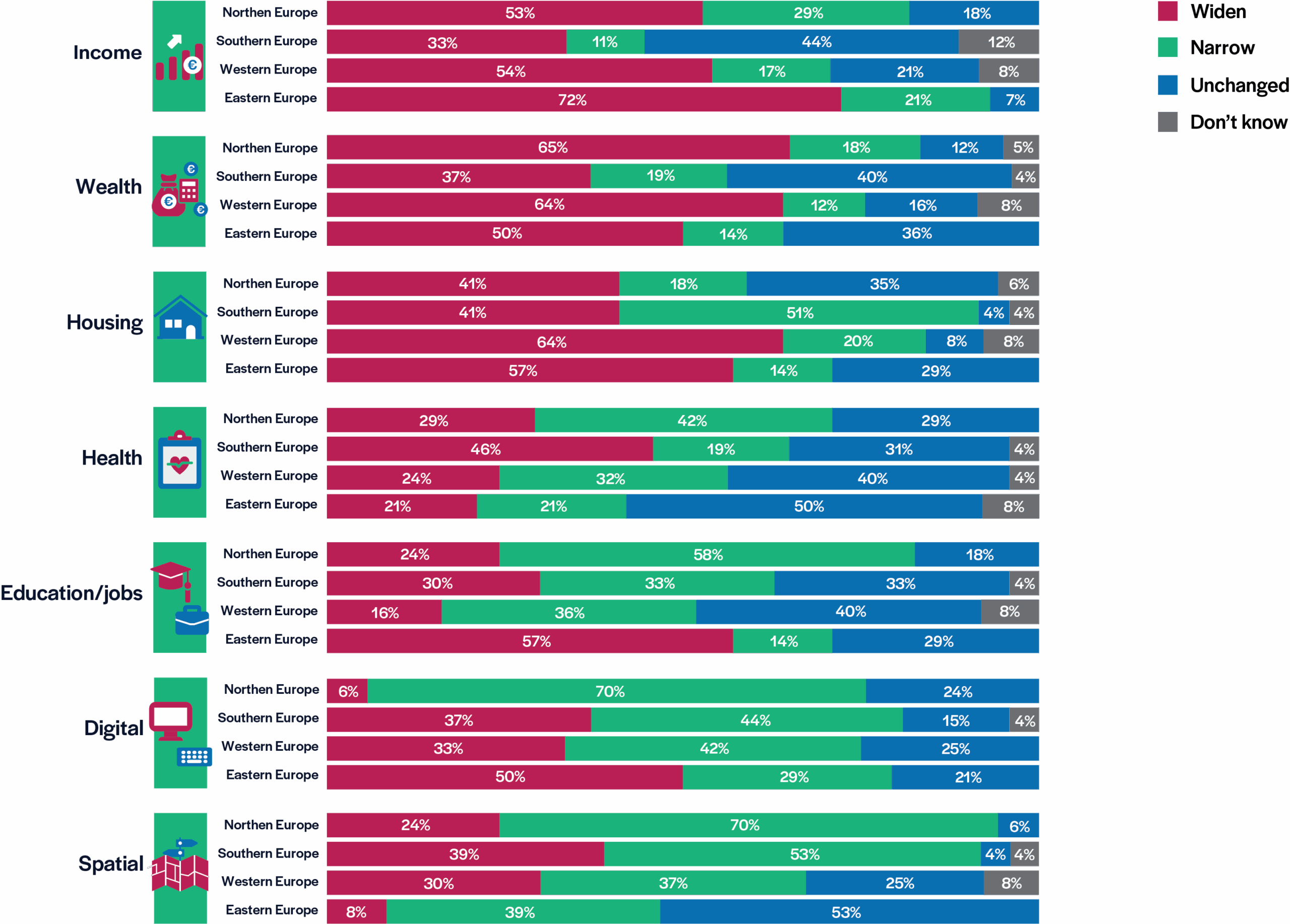
In Central-Eastern Europe, mayors are significantly more pessimistic about income and wealth disparities, with a higher expectation that these gaps will widen compared to Southern cities, where the outlook is comparatively more positive.
Northern and Western cities show greater confidence in reducing neighbourhood inequalities, reflecting more mature place-based policies, while this is far less evident in Central-Eastern Europe.
When it comes to housing, Southern European mayors are more hopeful, with a greater share anticipating affordability gaps to narrow. In other regions, particularly in the North and parts of Central-Eastern Europe, rising housing costs are expected to keep inequality high or make it worse.
How inequalities in cities will evolve over the next decade, by region
Regional differences
Levels of urban inequality vary across Europe, with different patterns emerging in different regions.
In Central-Eastern Europe, mayors are significantly more pessimistic about income and wealth disparities, with a higher expectation that these gaps will widen compared to Southern cities, where the outlook is comparatively more positive.
Northern and Western cities show greater confidence in reducing neighbourhood inequalities, reflecting more mature place-based policies, while this is far less evident in Central-Eastern Europe.
When it comes to housing, Southern European mayors are more hopeful, with a greater share anticipating affordability gaps to narrow. In other regions, particularly in the North and parts of Central-Eastern Europe, rising housing costs are expected to keep inequality high or make it worse.
How inequalities in cities will evolve over the next decade, by region
How mayors plan to tackle poverty
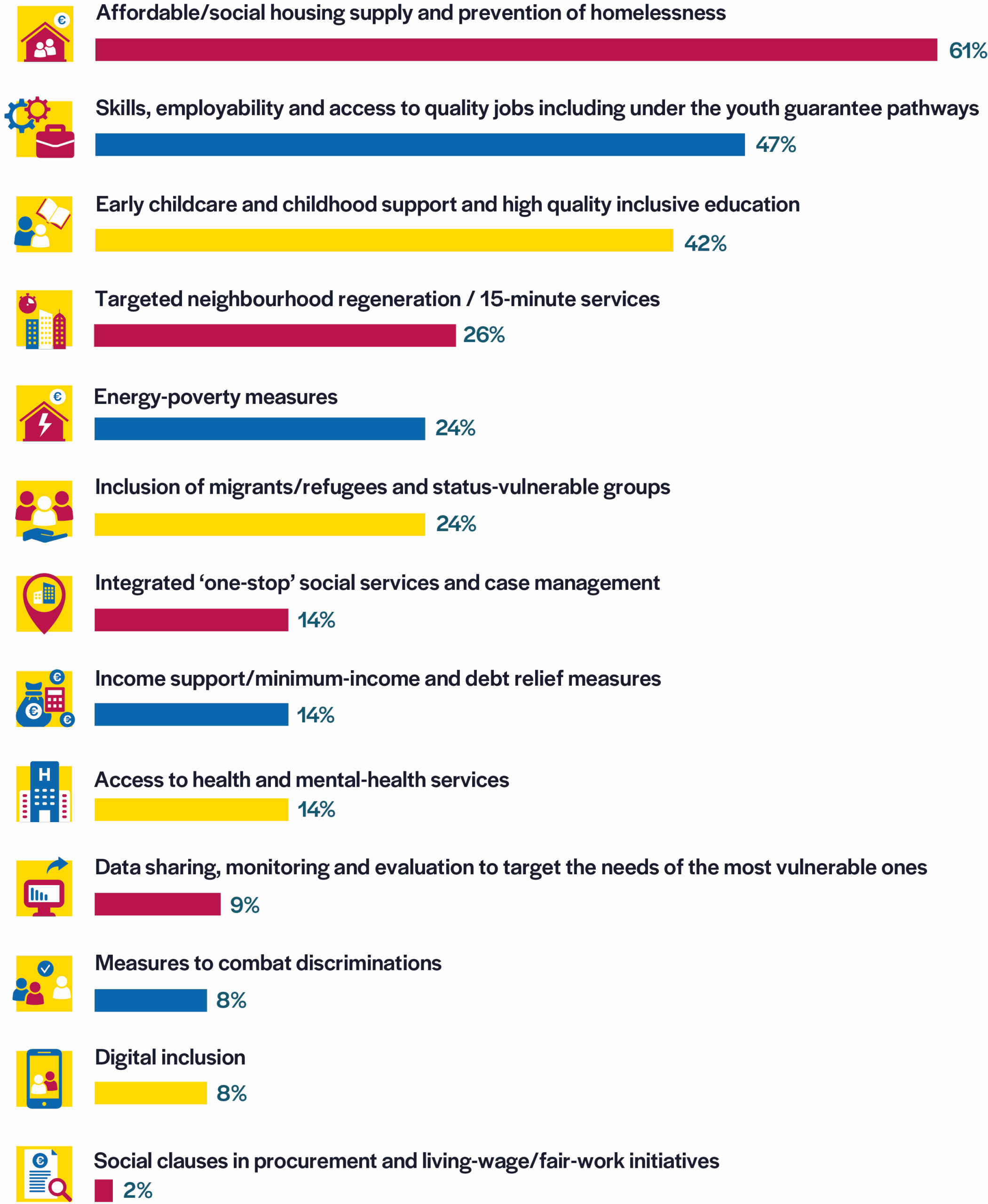
Tackling poverty is one of the main ways cities address urban inequalities, with mayors acting both where gaps are widening and where they can have the greatest impact on the most vulnerable. Across cities, mayors are putting stable housing, pathways into decent work, and a fair start in life at the heart of their anti-poverty strategies. Affordable and social housing, combined with strong homelessness prevention measures such as Housing First, rank as the top priority, selected by 61% of mayors. Mayors consider housing much more than the need for a shelter, it is the foundation for household stability, health, education and access to work.
Cities are also focusing strongly on skills, employability and access to quality jobs, chosen by 47% of respondents. Many are working with local employers and Youth Guarantee pathways to create routes into decent work that reflect real labour market needs. This suggests a move away from short-term job programmes towards support that better matches people’s skills, jobs and local opportunities.
Early childcare and high-quality inclusive education are also high on the agenda, selected by 42% of city leaders. They signal clearly that breaking the cycle of poverty means investing early, consistently and inclusively, before disadvantage becomes harder to reverse.
Targeted neighbourhood regeneration and 15-minute city services appear in 26% of responses, showing how cities are tackling the extra costs created by distance, poor connectivity and uneven access to services.
Energy poverty is another growing concern, with 24% of local leaders prioritising measures such as targeted renovation, bill support and heat or cooling plans. For mayors, the ability to keep homes warm in winter and cool in summer has become a frontline social issue.
Another 24% mention the inclusion of migrants, refugees and status-vulnerable groups. They focus on measures to remove administrative and practical barriers before they create structural inequalities.
Top priorities to tackle poverty in cities
How mayors plan to tackle poverty
Tackling poverty is one of the main ways cities address urban inequalities, with mayors acting both where gaps are widening and where they can have the greatest impact on the most vulnerable. Across cities, mayors are putting stable housing, pathways into decent work, and a fair start in life at the heart of their anti-poverty strategies. Affordable and social housing, combined with strong homelessness prevention measures such as Housing First, rank as the top priority, selected by 61% of mayors. Mayors consider housing much more than the need for a shelter, it is the foundation for household stability, health, education and access to work.
Top priorities to tackle poverty in cities
Cities are also focusing strongly on skills, employability and access to quality jobs, chosen by 47% of respondents. Many are working with local employers and Youth Guarantee pathways to create routes into decent work that reflect real labour market needs. This suggests a move away from short-term job programmes towards support that better matches people’s skills, jobs and local opportunities.
Early childcare and high-quality inclusive education are also high on the agenda, selected by 42% of city leaders. They signal clearly that breaking the cycle of poverty means investing early, consistently and inclusively, before disadvantage becomes harder to reverse.
Targeted neighbourhood regeneration and 15-minute city services appear in 26% of responses, showing how cities are tackling the extra costs created by distance, poor connectivity and uneven access to services.
Energy poverty is another growing concern, with 24% of local leaders prioritising measures such as targeted renovation, bill support and heat or cooling plans. For mayors, the ability to keep homes warm in winter and cool in summer has become a frontline social issue.
Another 24% mention the inclusion of migrants, refugees and status-vulnerable groups. They focus on measures to remove administrative and practical barriers before they create structural inequalities.
Where cities expect the next wave of social innovation to reduce poverty
The most promising social innovations identified by mayors align with their main priorities, confirming that innovation is a key tool for delivery.
What mayors are most proud of: policies and projects against poverty
Across Europe, mayors are pointing to practical, people-centred measures that help stabilise households, open pathways into employment and restore dignity. These examples show how cities are already making social rights real through practical support for residents.
Housing first, prevention always
Several cities are shifting from managing homelessness to ending it. Malaga’s Housing First programme provides permanent housing alongside personalised social support, helping reduce chronic homelessness. By offering stable housing from the start, it achieves better long‑term outcomes and reduces reliance on shelters and emergency services. This contrasts with traditional staircase approaches, which require people to move through shelters and meet conditions before accessing permanent housing, often delaying a stable move out of homelessness.
The city is also linking housing support with employment pathways through a new Dual VET office, connecting people to vocational training, apprenticeships and job opportunities while helping them stabilise their housing situation.
Dusseldorf and Haarlem follow the same principle: housing comes first, support follows. By giving people direct access to stable homes, then connecting them with tailored services, both cities are helping vulnerable residents rebuild their lives with dignity.
Madrid’s Dignitas strategy takes this further by moving from emergency response to prevention. Through tailored pathways out of homelessness and the citywide #igualquetú (same as you) campaign, Madrid is also challenging stereotypes and showing that homelessness can affect many different people, for a range of reasons.

Pathways to work designed with employers
Cities are building stronger routes into decent work by linking training more closely to existing local jobs. Espoo’s Youth Employment Programme helps young people gain the skills employers really need, making the transition from education to work more direct.
Malmo is doing this through city-employer coalitions that connect skills, vacancies and job matching. The approach is practical and targeted: understand the labour market, work with employers, and help people move from unemployment into stable work.
The Ukrainian city of Mariupol’s Entrepreneurship School supports displaced and vulnerable residents with business skills, financial literacy and digital tools. In a context of disruption, it helps people create new income streams and rebuild economic confidence.
Food security and basic needs, efficiently organised
Poznan provides 1,500 hot meals every day for people in need, offering simple and reliable support that helps households get through difficult periods.
Munich guarantees free social lunches at seniors’ and service centres, reducing food and income pressure for older residents while keeping social connection at the heart of support.
Safer, fairer streets for those furthest from help
Cities are strengthening outreach for people facing the deepest forms of exclusion. Bialystok funds a full chain of support, from warming centres, night shelters and care shelters to street outreach, meals and clothing. The aim is to meet people where they are and help them move back towards safety and stability.
Gijon is counting on cooperation between city agencies and NGOs, and a shared 2023-2030 roadmap to end homelessness.
Tampere’s Kaikkien Tampere programme brings equality, community and inclusion into mainstream city action, making integration and anti-discrimination part of how the city works every day.
Building systems that last
Cities are also investing in the capacity and governance needed to make anti-poverty action stick.
Vratsa has strengthened its municipal social services with new staff, training, supervision, a front office and public awareness campaigns, helping turn national frameworks into practical support for residents.
Zagreb’s ReStart programme supports homeless residents with tailored social services, helping them access the labour market, improve their employability and reconnect with city life.
Budapest is combining housing, energy and social innovation. Its Housing Agency renovates vacant municipal homes and leases private housing for social use, while the AHA project supports near-zero-energy social housing, an early warning system for energy poverty, flexible co-housing options and a revolving retrofit fund that brings in additional partners.

Cutting energy poverty and bills where people live
Cities are tackling energy poverty by helping residents lower bills, improve comfort and live in healthier homes. Krakow supports low-income households with grants to replace obsolete, polluting heating systems, reducing energy costs while improving air quality.
Athens has created an Energy Poverty Office as a one-stop shop for residents, offering advice and technical support for home renovations. This turns complex support schemes into practical upgrades people can access.
Netwerkstad Twente is working on a renovation deal that brings multiple housing renovation projects together into a coordinated programme, rather than running them as isolated schemes. This helps more households benefit from lower bills, safer homes and better living conditions.
Early years and learning as anti poverty policy
Istanbul’s Yuvamız Istanbul public preschools, now with 111 centres and growing, provide safe, high-quality early learning for thousands of children, expanding access in the years that matter most.
Turku is taking a citywide approach, investing in public schools and kindergartens to modernise learning environments and give children a stronger start.
Rotterdam’s Solid Start programme supports families from preconception to age four, focusing on healthy, safe and supportive early years. This includes access to parental support, preventive healthcare, quality childcare and early learning that strengthens children’s cognitive, social and emotional development.
The message is clear: investing early is one of the most powerful ways cities can reduce inequality over the long term.
One stop social services, delivered with dignity
Cities are making social services easier to access, especially for residents facing crisis or exclusion. Terrassa’s Andana initiative provides 24/7 temporary shelter, backed by a dedicated outreach team. It supports people through cold and heat waves, floods, sudden evictions and other emergencies, while connecting them to longer-term help.
Ghent is tackling one of the biggest barriers to social support: people missing out on support they are eligible for. By proactively combining data sources, the city identifies residents who are eligible for benefits and grants support automatically, reducing the administrative burden that too often keeps people from getting help.
Ungheni is lowering everyday barriers through practical, accessible services, including a social taxi, social wardrobe and fee exemptions for low-income families. The city is making sure people who are entitled to support can use it.

Using public money and data to reshape the playing field
Cities are using their budgets, contracts and data systems to make anti-poverty action more effective.
Genoa has introduced a minimum wage floor in public procurement, ensuring that city contracts do not support poverty wages.
Leipzig’s Deutschland Ticket Leipzig Pass gives low-income residents access to discounted public transport, helping stretch household budgets while improving access to jobs, education and services.
Odunpazarı’s Halk Market uses a cashless, dignity-first donation model. Donors allocate credits, beneficiaries choose what they need, and the system remains traceable without creating stigma.
Where cities expect the next wave of social innovation to reduce poverty
The most promising social innovations identified by mayors align with their main priorities, confirming that innovation is a key tool for delivery.
What mayors are most proud of: policies and projects against poverty
Across Europe, mayors are pointing to practical, people-centred measures that help stabilise households, open pathways into employment and restore dignity. These examples show how cities are already making social rights real through practical support for residents.
Housing first, prevention always
Several cities are shifting from managing homelessness to ending it. Malaga’s Housing First programme provides permanent housing alongside personalised social support, helping reduce chronic homelessness. By offering stable housing from the start, it achieves better long‑term outcomes and reduces reliance on shelters and emergency services. This contrasts with traditional staircase approaches, which require people to move through shelters and meet conditions before accessing permanent housing, often delaying a stable move out of homelessness.
The city is also linking housing support with employment pathways through a new Dual VET office, connecting people to vocational training, apprenticeships and job opportunities while helping them stabilise their housing situation.
Dusseldorf and Haarlem follow the same principle: housing comes first, support follows. By giving people direct access to stable homes, then connecting them with tailored services, both cities are helping vulnerable residents rebuild their lives with dignity.
Madrid’s Dignitas strategy takes this further by moving from emergency response to prevention. Through tailored pathways out of homelessness and the citywide #igualquetú (same as you) campaign, Madrid is also challenging stereotypes and showing that homelessness can affect many different people, for a range of reasons.
Cutting energy poverty and bills where people live
Cities are tackling energy poverty by helping residents lower bills, improve comfort and live in healthier homes. Krakow supports low-income households with grants to replace obsolete, polluting heating systems, reducing energy costs while improving air quality.
Athens has created an Energy Poverty Office as a one-stop shop for residents, offering advice and technical support for home renovations. This turns complex support schemes into practical upgrades people can access.
Netwerkstad Twente is working on a renovation deal that brings multiple housing renovation projects together into a coordinated programme, rather than running them as isolated schemes. This helps more households benefit from lower bills, safer homes and better living conditions.
Early years and learning as anti poverty policy
Istanbul’s Yuvamız Istanbul public preschools, now with 111 centres and growing, provide safe, high-quality early learning for thousands of children, expanding access in the years that matter most.
Turku is taking a citywide approach, investing in public schools and kindergartens to modernise learning environments and give children a stronger start.
Rotterdam’s Solid Start programme supports families from preconception to age four, focusing on healthy, safe and supportive early years. This includes access to parental support, preventive healthcare, quality childcare and early learning that strengthens children’s cognitive, social and emotional development.
The message is clear: investing early is one of the most powerful ways cities can reduce inequality over the long term.
One stop social services, delivered with dignity
Cities are making social services easier to access, especially for residents facing crisis or exclusion. Terrassa’s Andana initiative provides 24/7 temporary shelter, backed by a dedicated outreach team. It supports people through cold and heat waves, floods, sudden evictions and other emergencies, while connecting them to longer-term help.
Ghent is tackling one of the biggest barriers to social support: people missing out on support they are eligible for. By proactively combining data sources, the city identifies residents who are eligible for benefits and grants support automatically, reducing the administrative burden that too often keeps people from getting help.
Ungheni is lowering everyday barriers through practical, accessible services, including a social taxi, social wardrobe and fee exemptions for low-income families. The city is making sure people who are entitled to support can use it.
Pathways to work designed with employers
Cities are building stronger routes into decent work by linking training more closely to existing local jobs. Espoo’s Youth Employment Programme helps young people gain the skills employers really need, making the transition from education to work more direct.
Malmo is doing this through city-employer coalitions that connect skills, vacancies and job matching. The approach is practical and targeted: understand the labour market, work with employers, and help people move from unemployment into stable work.
The Ukrainian city of Mariupol’s Entrepreneurship School supports displaced and vulnerable residents with business skills, financial literacy and digital tools. In a context of disruption, it helps people create new income streams and rebuild economic confidence.
Food security and basic needs, efficiently organised
Poznan provides 1,500 hot meals every day for people in need, offering simple and reliable support that helps households get through difficult periods.
Munich guarantees free social lunches at seniors’ and service centres, reducing food and income pressure for older residents while keeping social connection at the heart of support.
Safer, fairer streets for those furthest from help
Cities are strengthening outreach for people facing the deepest forms of exclusion. Bialystok funds a full chain of support, from warming centres, night shelters and care shelters to street outreach, meals and clothing. The aim is to meet people where they are and help them move back towards safety and stability.
Gijon is counting on cooperation between city agencies and NGOs, and a shared 2023-2030 roadmap to end homelessness.
Tampere’s Kaikkien Tampere programme brings equality, community and inclusion into mainstream city action, making integration and anti-discrimination part of how the city works every day.
Using public money and data to reshape the playing field
Cities are using their budgets, contracts and data systems to make anti-poverty action more effective.
Genoa has introduced a minimum wage floor in public procurement, ensuring that city contracts do not support poverty wages.
Leipzig’s Deutschland Ticket Leipzig Pass gives low-income residents access to discounted public transport, helping stretch household budgets while improving access to jobs, education and services.
Odunpazarı’s Halk Market uses a cashless, dignity-first donation model. Donors allocate credits, beneficiaries choose what they need, and the system remains traceable without creating stigma.
Building systems that last
Cities are also investing in the capacity and governance needed to make anti-poverty action stick.
Vratsa has strengthened its municipal social services with new staff, training, supervision, a front office and public awareness campaigns, helping turn national frameworks into practical support for residents.
Zagreb’s ReStart programme supports homeless residents with tailored social services, helping them access the labour market, improve their employability and reconnect with city life.
Budapest is combining housing, energy and social innovation. Its Housing Agency renovates vacant municipal homes and leases private housing for social use, while the AHA project supports near-zero-energy social housing, an early warning system for energy poverty, flexible co-housing options and a revolving retrofit fund that brings in additional partners.
Cities’ biggest barriers to delivering anti poverty actions
Three barriers stand out across cities. The first is fragmented, short-term funding, cited by 52% of respondents. Money often arrives in one-year pots from different sources, making it difficult to plan long-term, combine funding streams or keep delivery teams in place. As a result, programmes can slow down or stop at the end of the year, even when they are showing results.
The second is the lack of affordable housing and high land costs, selected by 51% of cities. This turns strong prevention and support services into waiting lists. When suitable homes are scarce or too expensive, people remain stuck in emergency systems for longer.
Close behind, in third, is co-financing and match-funding requirements, cited by 33% of mayors. Even when grants are available, cities may struggle to provide the required local contribution within their budget cycle. This can leave funding unused or force projects to be scaled back.
Together, these barriers make it harder for cities to expand effective programmes, as short-term funding meets high housing costs.
Other delivery challenges add to the pressure. Complex rules, procurement and reporting requirements, selected by 27% of cities, slow down implementation and can exclude smaller community organisations that lack administrative capacity. Siloed governance, cited by 25%, makes it harder to coordinate action across housing, social services, health, education and employment.
Cities also point to staff shortages, turnover and skills gaps, which weaken continuity. Short political cycles make it harder to scale successful pilots. Data-sharing limits, legal constraints, risk-averse cultures, low service take-up, limited partnership capacity and outdated IT systems all create further friction.
Even when the policy direction is right, delivery systems still matter. Cities need stable funding, more affordable housing, simpler rules and stronger coordination to turn anti-poverty ambition into lasting impact.
Barriers to tackling poverty in cities
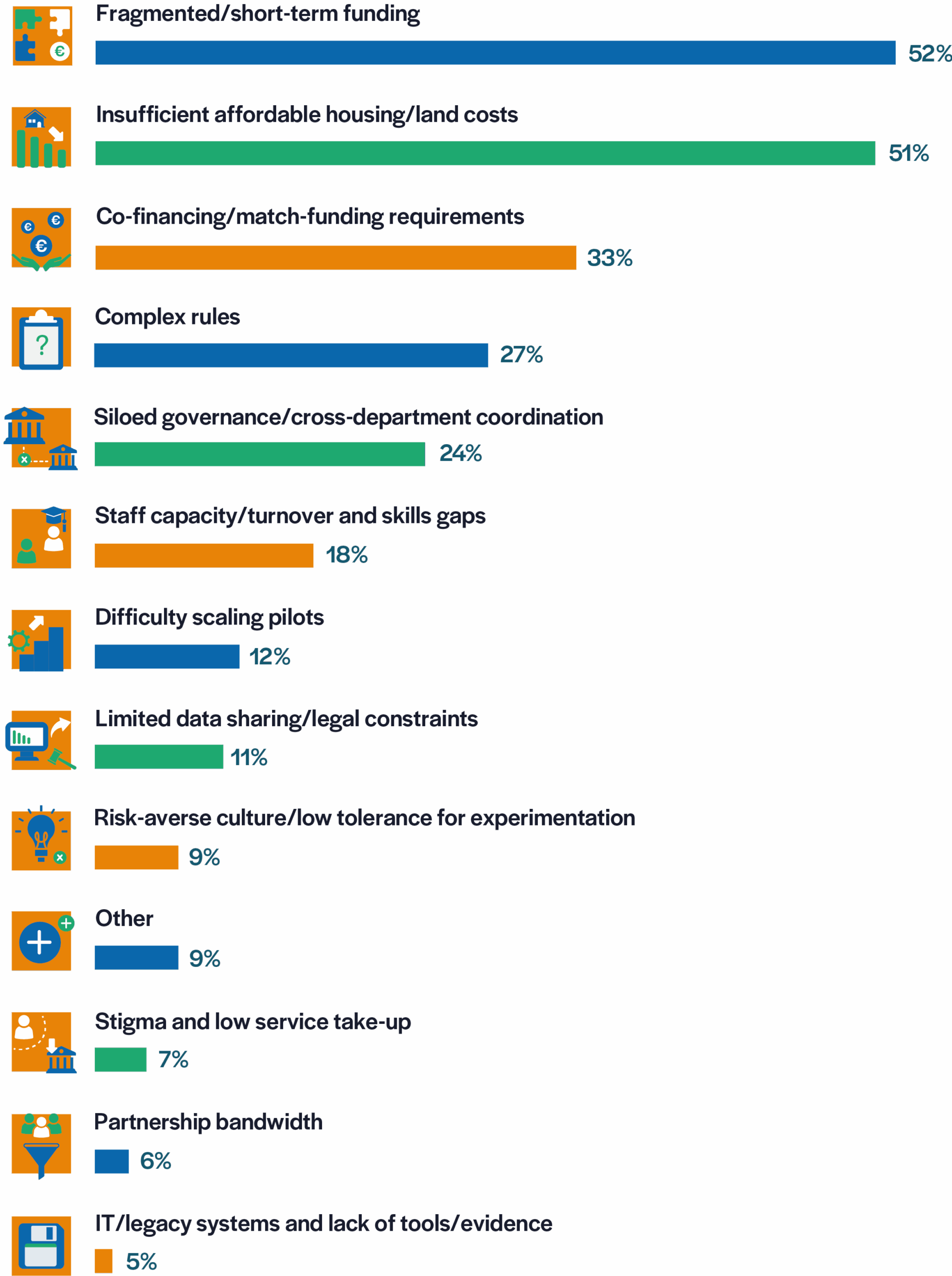
Cities’ biggest barriers to delivering anti poverty actions
Barriers to tackling poverty in cities
Three barriers stand out across cities. The first is fragmented, short-term funding, cited by 52% of respondents. Money often arrives in one-year pots from different sources, making it difficult to plan long-term, combine funding streams or keep delivery teams in place. As a result, programmes can slow down or stop at the end of the year, even when they are showing results.
The second is the lack of affordable housing and high land costs, selected by 51% of cities. This turns strong prevention and support services into waiting lists. When suitable homes are scarce or too expensive, people remain stuck in emergency systems for longer.
Close behind, in third, is co-financing and match-funding requirements, cited by 33% of mayors. Even when grants are available, cities may struggle to provide the required local contribution within their budget cycle. This can leave funding unused or force projects to be scaled back.
Together, these barriers make it harder for cities to expand effective programmes, as short-term funding meets high housing costs.
Other delivery challenges add to the pressure. Complex rules, procurement and reporting requirements, selected by 27% of cities, slow down implementation and can exclude smaller community organisations that lack administrative capacity. Siloed governance, cited by 25%, makes it harder to coordinate action across housing, social services, health, education and employment.
Cities also point to staff shortages, turnover and skills gaps, which weaken continuity. Short political cycles make it harder to scale successful pilots. Data-sharing limits, legal constraints, risk-averse cultures, low service take-up, limited partnership capacity and outdated IT systems all create further friction.
Even when the policy direction is right, delivery systems still matter. Cities need stable funding, more affordable housing, simpler rules and stronger coordination to turn anti-poverty ambition into lasting impact.
Which EU actions would make the Anti- Poverty Strategy relevant for cities?
Cities are clear about what they need from the EU Anti-Poverty Strategy: funding that is direct, predictable and simple to use.
The strongest ask is direct urban funding windows with simple applications and regular calls, backed by 69% of cities. This would help municipalities move away from constant grant-chasing and build more stable pipelines of anti-poverty projects.
The second priority is multiannual city envelopes with higher EU co-financing and funding paid upfront rather than reimbursed later, selected by 50% of cities. Cities need continuity and cashflow to scale programmes that work, rather than restarting them each budget cycle.
The third ask is a city-tailored InvestEU/EIB facility to acquire and renovate affordable homes and shelters, chosen by 42% of cities. This would help mayors count on a stable housing supply and a foundation for effective prevention, education, employment and inclusion.
In addition to the top three, cities point to other measures needed to deliver results. They want EU support to expand early years and school support in high-need areas (30%), and to reduce household pressure through targeted energy poverty schemes for low-income residents and social housing (26%).
They are also calling for services to be easier to access in one place, and for more support to expand Housing First programmes, which combine housing with tailored help. Both were selected by 25% of cities. The goal is to help people leave homelessness behind and ensure EU funding and programmes reach those who need it most.
Which EU actions would make the Anti- Poverty Strategy relevant for cities?
Cities are clear about what they need from the EU Anti-Poverty Strategy: funding that is direct, predictable and simple to use.
The strongest ask is direct urban funding windows with simple applications and regular calls, backed by 69% of cities. This would help municipalities move away from constant grant-chasing and build more stable pipelines of anti-poverty projects.
The second priority is multiannual city envelopes with higher EU co-financing and funding paid upfront rather than reimbursed later, selected by 50% of cities. Cities need continuity and cashflow to scale programmes that work, rather than restarting them each budget cycle.
The third ask is a city-tailored InvestEU/EIB facility to acquire and renovate affordable homes and shelters, chosen by 42% of cities. This would help mayors count on a stable housing supply and a foundation for effective prevention, education, employment and inclusion.
In addition to the top three, cities point to other measures needed to deliver results. They want EU support to expand early years and school support in high-need areas (30%), and to reduce household pressure through targeted energy poverty schemes for low-income residents and social housing (26%).
They are also calling for services to be easier to access in one place, and for more support to expand Housing First programmes, which combine housing with tailored help. Both were selected by 25% of cities. The goal is to help people leave homelessness behind and ensure EU funding and programmes reach those who need it most.